By Moolaram Mundliya Web Promotion Solutions

SEO And Online Marketing

Don't compromise your reputation...

Internet Marketing

Separate you from your competition...

Social Media Optimization

Way to make brand in the matkert...

Search Engine Optimization

Making it unique and memorable...

Mobile Marketing

Its time to changing...

Wednesday, January 4, 2012

Ranking Tools: This Week in Social Media

Multiple Google+ Page Managers Now Possible:

There are a few new features on Google+ Pages including multiple admins, or page managers. You can now have up to 50 page managers for your business page. There are also notifications for page managers to stay in the loop.


Here are a few social media tools:

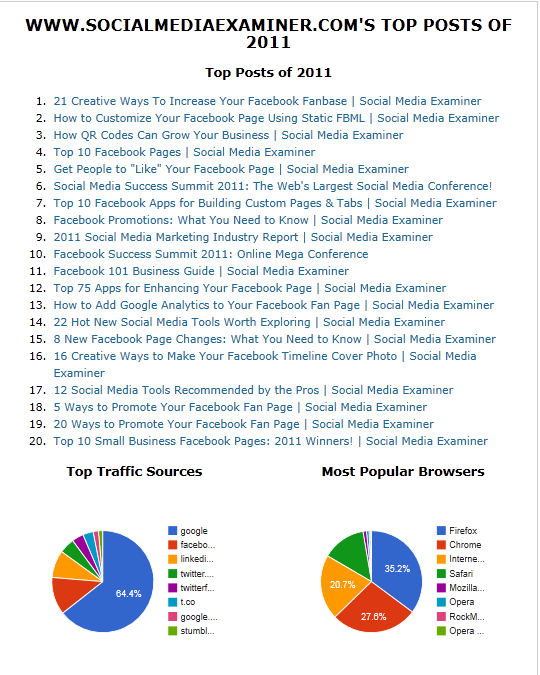
Shareaholic’s Top Posts App: This app shows bloggers their most popular content, keywords, traffic sources and demographics for 2011 by leveraging Google Analytics.


ZoomSphere: This nifty tool ranks the top brand pages on Google+, Facebook and Twitter.


incentiBox: This is a free community rewards program solution to allow e-commerce stores to create their own social media–based customer rewards program.


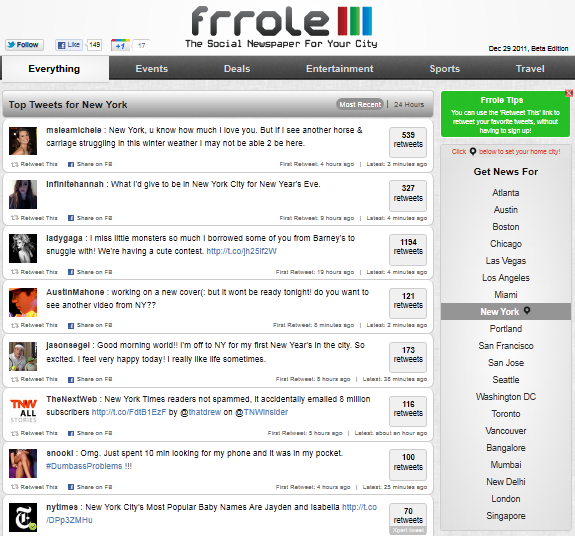
Frrole: This allows you to follow locally relevant social news on Twitter.


Reference Link: http://www.socialmediaexaminer.com/ranking-tools-this-week-in-social-media/

Wednesday, December 28, 2011

FREE Google PageRank™ Tool for your web site/blog


Anything you need to know about the big G http://www.thegooglepagerank.com/google-news.htm

Tuesday, July 19, 2011

The 20 Most Expensive Keyword Categories In Google AdWords?

Google makes a heck of a lot of money from online advertising. In fact, 97 percent of Google’s revenue, which totaled $33.3 billion in the past twelve months, comes from advertising.
WordStream, a venture capital-backed provider of hosted software that automates most of the manual work involved with creating and optimizing both paid and natural search engine marketing campaigns, has done some research to discover which keyword categories fetch the highest costs per click (CPC) in Google’s AdWords solution.
And of course, they made an infographic based on the results of their research (embedded below).
WordStream compiled data from its own, vast keyword database and the Google Keyword Tool to determine the top 10,000 most expensive English-language keywords over a 90-day period.
Subsequently, the list was organized into categories by theme. The largest keyword categories were then determined by weighting the number of keywords within each category, as well as the estimated monthly search volume and average cost per click for each keyword.
For the record, Google AdWords is an auction-based marketplace where advertisers bid on keywords to compete for top ad placement, with a minimum bid of 5 cents per keyword (update: actually, there’s no longer a minimum bid for CPC campaigns).
The top twenty keyword categories that demanded the highest costs per click are:
1. Insurance (example keyword: “auto insurance price quotes”)
2. Loans (example keyword: “consolidate graduate student loans”)
3. Mortgage (example keyword: “refinanced second mortgages”)
4. Attorney (example keyword: “personal injury attorney”)
5. Credit (example keyword: “home equity line of credit”)
6. Lawyer
7. Donate
8. Degree
9. Hosting
10. Claim
11. Conference Call
12. Trading
13. Software
14. Recovery
15. Transfer
16. Gas/Electricity
17. Classes
18. Rehab
19. Treatment
20. Cord Blood
Unsurprisingly, the list of most expensive keyword categories is clearly a result from people who, en masse, turn to the Web in search for help, whether it’s for financial, educational, professional services or medical aid. WordStream concludes that the keyword categories with the highest volumes and costs represent industries with very high lifetime customer value: in other words, companies that can afford to pay a lot to acquire a new customer because of the nature of their business.
But I would have personally never imagined that ‘insurance’ would be netting Google up to almost $55 per click. Think about that for a minute.

Monday, June 13, 2011

Facebook Accounts For 38 Percent Of Sharing Traffic On The Web

Sharing is big on the Web. Looking across the sharing and clicking habits of the more than 300 million people a month who pass links with a ShareThis button on over a million websites (producing 7 billion pageviews a month), a few things stood out. Overall, sharing now produces an estimated 10 percent of all Internet traffic and 31 percent of referral traffic to sites from search and social. Search is still about twice as big.
When it comes to sharing on the Web, Facebook rules. Facebook accounts for 38 percent of all sharing referral traffic. Email and Twitter tied for second with 17 percent each. Those are the percentages that actually clicked through. The raw sharing numbers are higher. Facebook makes up 56 percent of all shared content (up from 45 percent in August, 2010), followed by email at 15 percent (down from 34 percent) and Twitter at 8 percent (down from 12 percent). The difference between these two sets of numbers is that some content is shared that is never clicked on, thus the raw numbers are higher.
Facebook may be gaining share, but Twitter is holding its own in terms of actual clicks. On average, Twitter links are clicked on 4.9 times each, versus 4.3 times for Facebook links and 1.7 times for emailed links.

Reference Link :  http://tcrn.ch/jFoRBw

Friday, May 6, 2011

Google Panda Treating Open Publishing Platforms Differently

Search engines are a critical part of the democratization of the Web and none is more important than Google. They provide the critical gateway to information in a meritocratic way that has traditionally rewarded usefulness and quality over name recognition of the content creator, valuing the utility to the searcher over all else.
In parallel, open publishing platforms have provided free tools for creating and sharing information with topical expertise and a voice to anyone on the Web. These platforms feed the search engines and, in return, the search engines have delivered steady audiences. This ecosystem has been lucrative for the search engines, an essential outlet for the information sharers, and a great way for the world to have access to a broad swathe of information, from the full range of political opinions to thousands of ways to barbecue a chicken.
Google’s recent “Panda” update intentionally upends this ecosystem; it doesn’t just lower the rankings of individual pages that the algorithm deems “low quality” (however that may be defined by Google) but, as Google has said publicly, “low-quality [page] content [on the domain] can impact an entire domain.” This means that high-quality content hosted on open publishing platforms like HubPages and YouTube can be negatively impacted in their search rankings simply by hosting contributions of various quality on a single site.
HubPages has seen a negative impact from this change, but so far YouTube has not (Search Metrics Winners). One presumes Google isn’t treating its own affiliated sites differently than any other site, but YouTube’s open publishing environment makes low-quality content as prevalent as on any other moderated open publishing platform. Google shows over 13 million indexed videos on YouTube for lose weight (known spammy area) and over 10 million forforex (another spammy area). Apparently, Google’s Panda update has been punitive only to platforms other than Google’s.
Before Panda, Google gave open platforms of all sizes many ways to separate high quality content from poor content without chilling an entire domain. In this respect, HubPages most closely resembles YouTube’s site structure. We send Google signals by how we program the site. For example, we let Google know what we think is the best content by giving that content more internal links from related pages. We also follow the sitemap protocol and give content a crawling priority. It seems these efforts are severely discounted after the Panda update since, despite their application, there is still a domain-wide devaluing being applied.
Google is targeting platforms other than its own and stifling competition by reducing viable platform choices simply by diminishing platforms’ ability to rank pages. Google is not being transparent about their new standards, which prevents platforms like ours from having access to a level playing field with Google’s own services. We want to comply with and exceed Google’s standards. Google has my contact information. Hope to hear from them soon.


Thursday, April 7, 2011

The Most Popular Search Engines

This summary is not available. Please click here to view the post.

moolaram.mundliya@gmail.com. Powered by Blogger.

 
Twitter Bird Gadget